
Understanding silk
Why we love silk
Despite its delicate appearance, silk is one of the strongest natural fabrics. Its fibers refract light at multiple angles, giving it its characteristic sheen and luminous quality. It is the only naturally occurring continuous filament fiber, which also contributes to its strength.
A filament is a continuous thread. Silk filaments range from 600 to 1500 meters. Meanwhile, a cotton or wool thread for example is made of multiple strands, ranging from one to 20 centimeters, twisted together into a long thread.
Silk is naturally thermoregulating: silk fibers adjust to body temperature, ensuring a cool, dry experience in warm conditions and providing insulation in cold conditions.
Silk is also hypoallergenic, biodegradable within months under composting conditions, and has excellent dye uptake, producing rich, deep colors.
What's wrong with silk
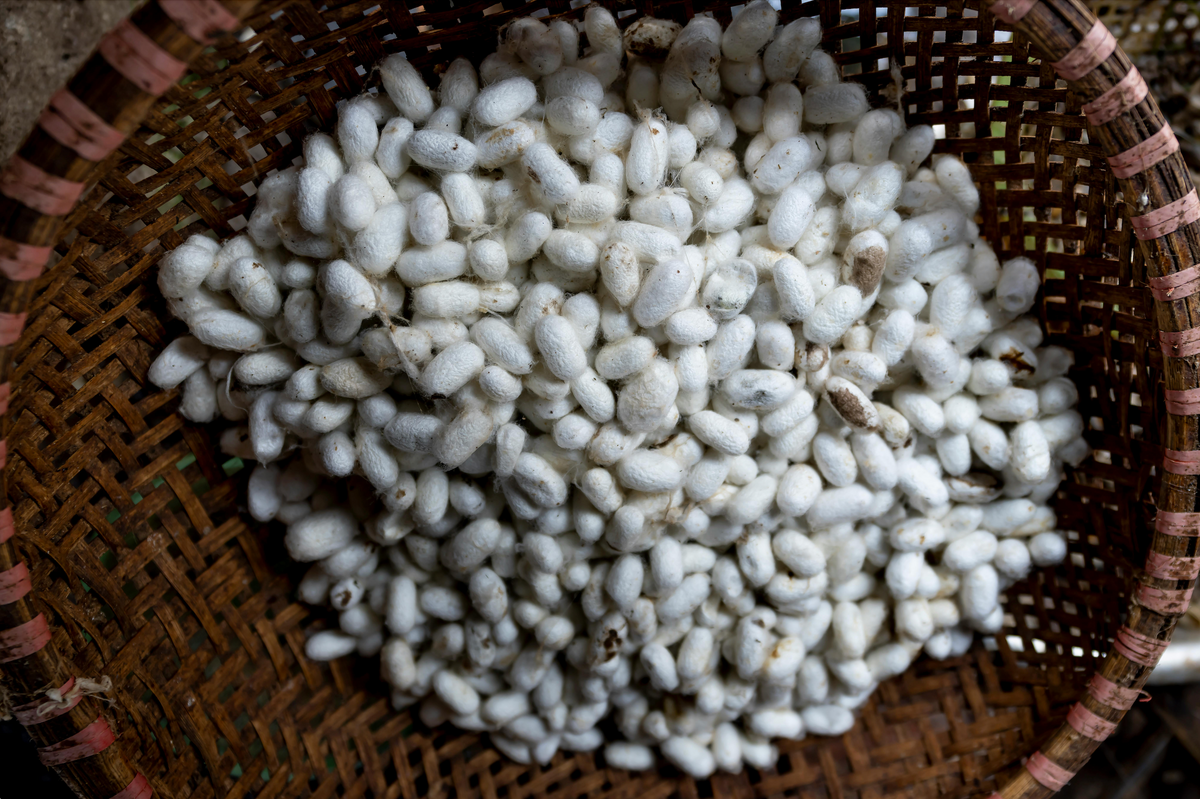
Silk ranks higher than virtually all other fibers in terms of environmental impact. This fiber is produced by the Bombyx Mori, a worm that feeds on mulberry leaves to grow. It takes 187 kg of mulberry leaves to produce 1 kg of silk. A lifecycle analysis of raw silk production in China identified mulberry cultivation as accounting for 46% of total environmental impact, with terrestrial ecotoxicity, freshwater ecotoxicity, and human carcinogenic toxicity among the primary impact categories.
Silk production also has a high carbon footprint, driven by high energy use for climate control, reeling, processing, and boiling water during cocoon harvesting. Most silk comes from China and India, where sericulture facilities are often coal-powered.
Social & animal welfare
On social conditions: the four most significant silk-producing countries are reported by the Global Slavery Index to have high modern slavery risks, with forced and child labor documented in Uzbekistan and India.
On animal welfare: silkworms (Bombyx mori) are killed during cocoon harvesting, typically by boiling or steaming, in order to keep the silk filament intact. The mulberry silkworm has been fully domesticated over centuries and cannot survive outside captivity. The species can no longer fly and its mouth structures are underdeveloped — it lives only long enough to spin its cocoon.
Our only choice is deadstock
We love silk, but we don’t want to contribute directly to its production since its impacts are not as manageable and its sourcing as traceable as other fabrics.
Unless we find a more sustainable way to do things, we choose to only use deadstock silk fabrics. Using deadstock fabrics does not create new demand for production it diverts a product that already exists away from destruction or recylcing into lesser quality fabrics. Our silk garments should be treasured for what they are: limited, curated pieces to be loved and passed-down, not mere commodities.
Read more